

General research for information only — not legal, tax, or investment advice. Cambodian law and markets change; figures are indicative, so verify current detail with a qualified local professional before you act.
In the space of seven days, Cambodia’s banking sector collected four new
external rankings: Forbes named its first-ever global top performer, Euromoney
handed out a digital-banking award, and a new domestic platform started
scoring every bank in the country by asset tier. None of these measure the
same thing, and — this matters more than any of the individual placements —
one of the four explicitly says it is not a recommendation on where to keep
your money. This platform’s banking coverage has so far run entirely on
regulatory and market data: NBC’s non-performing-loan figures, Moody’s
regional comparison, AMRO’s stress test, three 2026 liquidations. This is the
first look at the third-party scoring layer that sits between a bank and its
customers — and the gap between what these rankings measure and what a
depositor or property buyer actually needs to know is the whole story.
Citations are marked [S-N]; the source list is at the end.
Three rankings, three different claims
Forbes’ World’s Top Performing Banks 2026 is a debut global ranking, produced with Statista, assessing 500 banks from 89 countries against four weighted dimensions: profitability (30%), capital and funding resilience (25%), asset quality and efficiency (25%), and growth and earnings quality (20%) [S-2]. Eligibility required more than $3 billion in assets, audited financial statements, and at least three consecutive years of data — a floor that excludes most of Cambodia’s banking sector by definition [S-2].
Euromoney’s Awards for Excellence named Wing Bank Cambodia’s Best Digital Bank 2026, presented in Singapore [S-3]. This is an editorial award judging product, brand and digital-banking execution — not a quantitative financial-performance ranking, and not a claim about balance-sheet strength.
SuperBankRatings, a research and rating platform under Andersen Consulting Cambodia launched in March 2026, published the first of four planned asset-cohort rankings in its inaugural Cambodia SuperPower Banking Index 2026 — this opening cohort covering banks with 2025 assets under $1 billion [S-1]. State this plainly, in the first section rather than buried in a caveat at the end: SuperBankRatings is vendor-produced and self-disclaimed. Its own release describes the index as “an analytical peer ranking, not a regulatory rating or a recommendation on where to deposit money” [S-1]. It is explicitly positioned as a complement to the same consultancy’s own credit and bond ratings, not a substitute for either a credit rating or regulatory supervision.
Three different instruments, three different claims: financial performance, brand and product, and a private, vendor-built institutional-quality index. Reading any one of them as “safest bank in Cambodia” misreads all three.
Forbes, in detail: a floor most Cambodian banks don’t clear
Forbes’ inaugural ranking placed ABA Bank 31st worldwide in the Lower Mid-Size Banks tier — institutions with $10–20 billion in total assets — the highest-ranked Cambodian institution [S-2]. ACLEDA Bank ranked 107th in its own peer tier, the only other Cambodian entrant [S-2]. Forbes says banks do not pay to participate, and the assessment draws on financial data from providers, desk research and bank submissions rather than the customer surveys some of Forbes’ other bank rankings use [S-2].
ABA CEO Askhat Azhikhanov called the recognition “particularly meaningful” for being benchmarked “among banks from around the world using objective financial performance indicators,” attributing the result to customer trust and the bank’s focus on building “a strong, resilient and forward-looking bank” [S-2].
The honest limit is the eligibility floor itself: more than $3 billion in assets excludes the tier of Cambodian banks — smaller commercial banks and microfinance deposit-takers — where this platform’s own coverage of 2026’s bank and payment-provider failures has actually been concentrated. Forbes says something real about ABA and ACLEDA specifically. It says nothing about the sub-$1-billion tier where SuperBankRatings’ own index starts.
SuperBankRatings, in detail: what the index actually measures
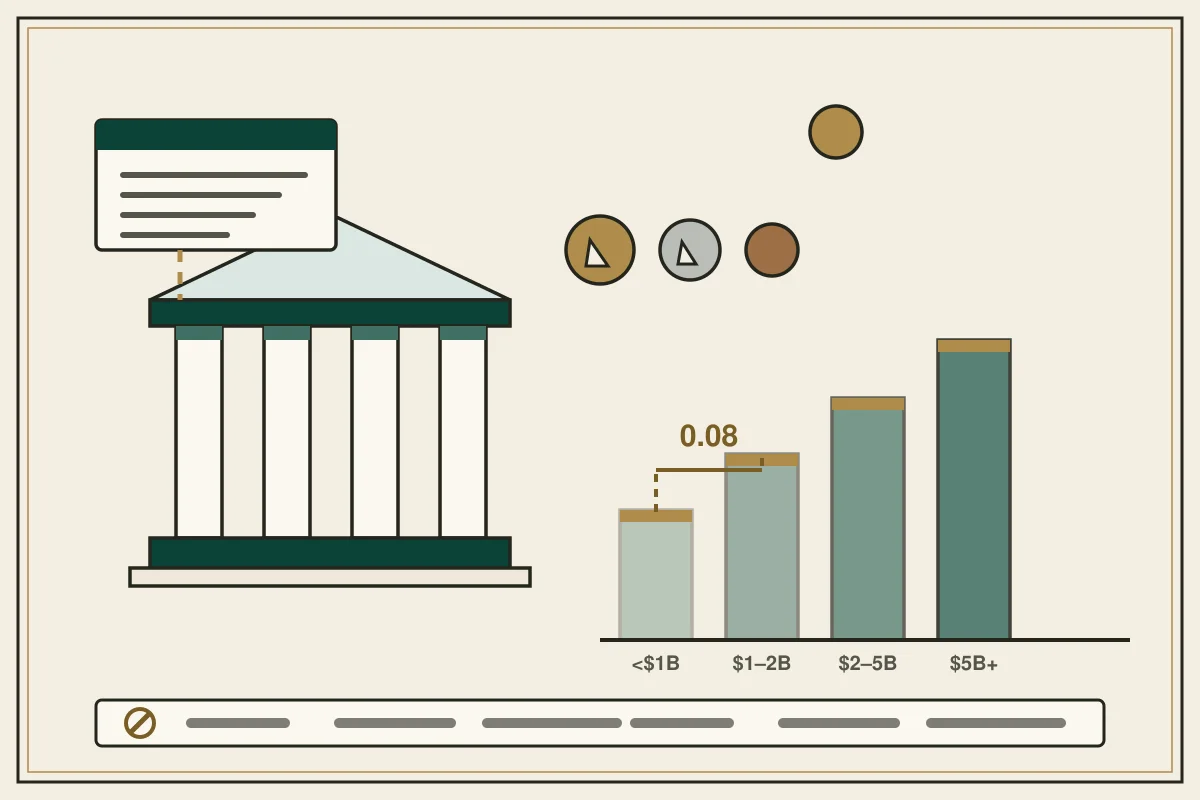
The index combines 40% quantitative and 60% qualitative analysis across 11 parameters and 329 benchmark points, covering governance, financial strength, funding and liquidity, risk management, sustainability and technology [S-1]. Andersen Consulting Cambodia reviewed 49 bank assessments, of which 31 institutions met the asset criteria for this opening under-$1-billion cohort [S-1]. Asset size determines which of the four cohorts a bank is scored in; it does not determine a bank’s position within that cohort [S-1]. Three further cohorts are scheduled across the rest of the month — the $1–1.99bn and $2–4.99bn tiers around 18 September, and the $5 billion-and-above tier on 21 September, per the release [S-1] — meaning the picture this article describes is a first tranche, not the full sector.
The platform also runs Gold/Silver/Bronze “Value for Customer” tiers alongside the numeric index, and has announced sibling platforms — SuperCommsRatings, SuperCryptoRatings, SuperESGRatings, SuperInsuranceRatings and SuperWealthRatings — extending the same scoring approach into other sectors [S-1]. None of that expansion is scored or verified here; it is recorded because a second or third of those platforms producing something with property-relevant consequences would be worth its own coverage later.
The honest core: 0.08 points separate the top five
This is the number that should anchor how anyone reads this index. Just 0.08 points, out of 329 possible, separate the five highest-scoring banks in the opening cohort [S-1]. SuperBankRatings names only two of the five: Mizuho, whose strength reflects its global parent’s financial backing, capital and liquidity, and ARDB, whose assessment reflects its government links and role in Cambodia’s development priorities [S-1]. The other three top-five banks are not named in the release, and no methodology document, raw score table, or full 31-bank cohort listing has been published [S-1].
A 0.08-point spread across an 11-parameter, 329-point framework is a practical tie, not a meaningful order. Treat “top five” as a cluster, not a league table — the platform’s own data does not support ranking Mizuho above ARDB, or either above the three unnamed banks, with any real precision. This is the single most important caveat in this piece, because a Gold/Silver/Bronze badge reads to a customer as a ranking with a winner, and the numbers behind it do not support that reading for the top tier.
What each ranking will actually be used for
Realistically: Forbes and Euromoney will be used in bank marketing. Both are the kind of external recognition banks put in annual reports and branch materials — legitimately earned, but promotional once repurposed. SuperBankRatings’ Gold/Silver/Bronze badges will likely serve the same function for the banks that score well, even though the platform’s own language is explicit that this is not what the index is for. Re-read its disclaimer in full, because it is doing real work here: “an analytical peer ranking, not a regulatory rating or a recommendation on where to deposit money” [S-1]. That sentence exists because the platform anticipated exactly the use — reassurance-shopping by depositors — that its own methodology cannot support.
None of the four rankings substitutes for supervision. Cambodia’s National Bank licenses and supervises every deposit-taking institution in the country; that supervisory relationship, not a private index or a global performance ranking, is the actual backstop behind a bank’s ability to operate. Nothing in Forbes, Euromoney or SuperBankRatings changes NBC’s supervisory posture toward any of the banks involved.
What actually protects a deposit in Cambodia
This platform’s own reporting on 2026’s banking-sector stress is the more directly useful reference point than any of this week’s rankings. Cambodia’s system-wide non-performing loan ratio stood at 9.6% as of H1 2026, the highest in the region on Moody’s regional comparison, with construction and real estate flagged as a slow-recovery concentration. Three linked institutions — two commercial banks and a payment provider — went into liquidation earlier in 2026, and this platform’s coverage of that episode found the harder gap: Cambodia still has no deposit insurance scheme, one of the only countries in ASEAN+3 without one. NBC and the Ministry of Economy and Finance have a working group studying a proposed “Deposit Protection and Bank Resolution Unit,” but as of this writing that remains a feasibility study, not law. Until it exists, what protects a depositor is the orderliness of a case-by-case liquidation, not a guaranteed payout — and a property buyer holding an escrow balance, a developer’s project account, or mortgage financing through any Cambodian bank should be asking about counterparty concentration and NBC licensing status directly, not checking which badge a bank has been awarded this month.
What to watch
- The 18 and 21 September SuperBankRatings cohorts. The $1–1.99bn, $2–4.99bn and $5bn-plus tiers will bring Cambodia’s largest banks — including ABA and ACLEDA — into the same scoring framework, and a full picture only exists once all four cohorts are published.
- Whether SuperBankRatings releases a methodology document or a full score table. Until it does, every cohort result is a headline figure from a vendor release, not an auditable ranking.
- Whether any bank markets a SuperBankRatings badge as a safety signal rather than the “institutional quality” measure the platform itself defines it as — the gap between those two framings is exactly where this kind of index tends to get misread.
- Progress, if any, on NBC’s proposed deposit-protection unit — the actual structural gap none of this week’s rankings touches.
The takeaway
Four rankings landed on Cambodia’s banking sector in a single week, and they are not competing versions of the same claim — they are three different claims wearing the same word. Forbes measured financial performance against a global, $3-billion-and-up peer set and placed ABA 31st and ACLEDA 107th. Euromoney handed Wing Bank an editorial award for digital-banking execution. SuperBankRatings began scoring the tier of banks the other two don’t reach, under a methodology that explicitly disclaims being a safety recommendation — and inside its own first cohort, the top five are separated by a margin so small it should be read as a tie. None of the four changes what actually protects a Cambodian bank deposit: NBC licensing and supervision, and — the gap every one of these rankings quietly steps around — a deposit-insurance scheme the country still does not have. None of this is investment or banking advice; verify current NBC licensing status and any specific bank’s disclosed financials directly before treating a ranking, award or badge as a safety signal.
Sources
- [S-1] Cambodia Investment Review — SuperBankRatings Launches Cambodia’s Under-$1 Billion Bank Ranking to Compare Institutional Strength — inaugural Cambodia SuperPower Banking Index 2026, opening under-$1bn cohort; Andersen Consulting Cambodia; 49 assessments/31 qualifying institutions; 40%/60% quant/qualitative across 11 parameters and 329 benchmark points; 0.08-point spread across the top five (Mizuho, ARDB named); Gold/Silver/Bronze “Value for Customer” tiers; sibling platforms; further cohorts through 21 September; self-disclaimer quoted in full. Published 16 Sep 2026.
- [S-2] Cambodia Investment Review — ABA Bank Named Cambodia’s No. 1 Bank in Forbes’ World’s Top Performing Banks 2026 — Forbes’ debut ranking with Statista; 500 banks/89 countries; >$3bn eligibility floor, audited statements, 3+ years of data; four weighted dimensions (profitability 30%, capital/funding resilience 25%, asset quality/efficiency 25%, growth/earnings quality 20%); ABA 31st in Lower Mid-Size ($10-20bn), ACLEDA 107th; CEO Askhat Azhikhanov quoted. Published 16 Sep 2026.
- [S-3] Cambodia Investment Review — Euromoney Names Wing Bank Cambodia’s Best Digital Bank 2026 — Euromoney Awards for Excellence, Singapore; Wing Bank’s own reported scale (15M+ customers, 12,000+ agents, ~30 branches, 200,000+ merchants); 2025: 600M+ transactions worth ~$55bn, ~$3.6bn assets, $2.99bn deposits, $2.23bn loans; digital lending
1.7M customers/$349M disbursed. Published 16 Sep 2026.
Frequently asked questions
What is SuperBankRatings, and is it a credit rating agency?
No. SuperBankRatings is a research and rating platform under Andersen Consulting Cambodia, launched March 2026. It explicitly distinguishes itself from a credit rating, describing its index as measuring institutional quality, execution capability, governance and resilience rather than default risk. Its own release calls the result 'an analytical peer ranking, not a regulatory rating or a recommendation on where to deposit money.'
Where did ABA and ACLEDA rank in the new Forbes list?
ABA Bank placed 31st in the Lower Mid-Size Banks tier ($10-20bn in assets) — Cambodia's highest-ranked institution — and ACLEDA placed 107th in its own tier, in Forbes' debut World's Top Performing Banks 2026, produced with Statista. Eligibility required more than $3bn in assets, audited statements and at least three years of financial data, so the ranking says nothing about banks below that floor.
Does a high ranking mean a bank is safe to deposit money with?
Not directly. Forbes measures financial performance against similar-size global peers; Euromoney's award is an editorial call on digital-banking product and brand; SuperBankRatings measures institutional quality and governance, and says so itself. What actually governs deposit safety in Cambodia is NBC licensing and supervision — and Cambodia still has no deposit insurance scheme, a gap this platform covered after three 2026 bank and payment-provider failures.
How close is the top of SuperBankRatings' first cohort?
Just 0.08 points separate the top five banks under $1 billion in assets, out of 329 possible benchmark points across 11 parameters. SuperBankRatings names only two of those five — Mizuho, for parent backing, capital and liquidity, and ARDB, for its government links and development mandate. A 0.08-point spread is a practical tie, not a meaningful ranking order, and the platform has not released a full cohort table.