

General research for information only — not legal, tax, or investment advice. Cambodian law and markets change; figures are indicative, so verify current detail with a qualified local professional before you act.
Cambodia’s Prime Minister used a hospital inauguration to say something with
real consequences for border-town land: casino operators must now clear a
$100 million minimum capital requirement, up from a floor so low that, in
his own words, “even a small building could open a gambling area.” Read this
for exactly what it is before reading it for what it might mean. It is a
single-source readout of remarks made at a ceremony, not a policy
document — every figure below traces to Prime Minister Hun Manet himself,
there is no sub-decree, prakas or licensing circular cited anywhere in the
source, and no operator, province-level count, revenue figure or land
valuation appears in it either. This platform’s existing border-town coverage
describes the casino-and-SEZ economy and the demand collapse the scam
crackdown has already caused. What has been missing is treating the casino
licence itself — not the building, not the town — as the actual asset
that prices border land. This is that piece. Citations are marked [S-N];
the source list is at the end.
What was actually said
Speaking at the inauguration of the Luang Mè Hospital in Phnom Penh, Hun Manet acknowledged the economic pain the online-scam crackdown has caused in Poipet, tied that pain to Cambodia’s wider tourism decline, and then turned to casino policy directly [S-1]. He said he has instructed relevant authorities to review the number of casinos operating in Cambodia — about 100 — and assess whether the country has too many [S-1]. In the same remarks: “We have increased the requirements for operating casinos, which require up to $100 million,” he said, contrasting it with a prior regime so permissive that a small building could qualify [S-1]. He restated the policy rationale for allowing casinos in border provinces at all: to attract “additional economic activities, just like in Las Vegas and Macau cities,” generating demand for restaurants and other rural businesses [S-1] — his framing, not a line from any policy text.
The licence, not the building, is the asset
This platform’s own border-town guide already makes the underlying point qualitatively: casino footfall in Bavet and Poipet is “underwritten to a policy decision,” not to the buildings themselves. The $100 million figure makes that literal. A casino licence in Cambodia has functioned as the scarce input that turns an ordinary border plot into a specific, higher-value use — hospitality, gaming floor, ancillary retail — precisely because licensing, not zoning or location alone, has determined who could build what. The scam crackdown has already hit the demand side of that equation hard: this platform’s coverage of the crackdown’s effect on border-town property found operators and workers leaving Poipet, Bavet and Chrey Thom, with FASMEC’s own vice-president acknowledging that some border-area building stock was “partly driven by demand associated with online scam operations.” A $100 million capital floor is a supply-side move layered on top of that demand-side collapse — it changes who can enter the licensed-casino business, not whether the customers who left are coming back.
The floor as a filter
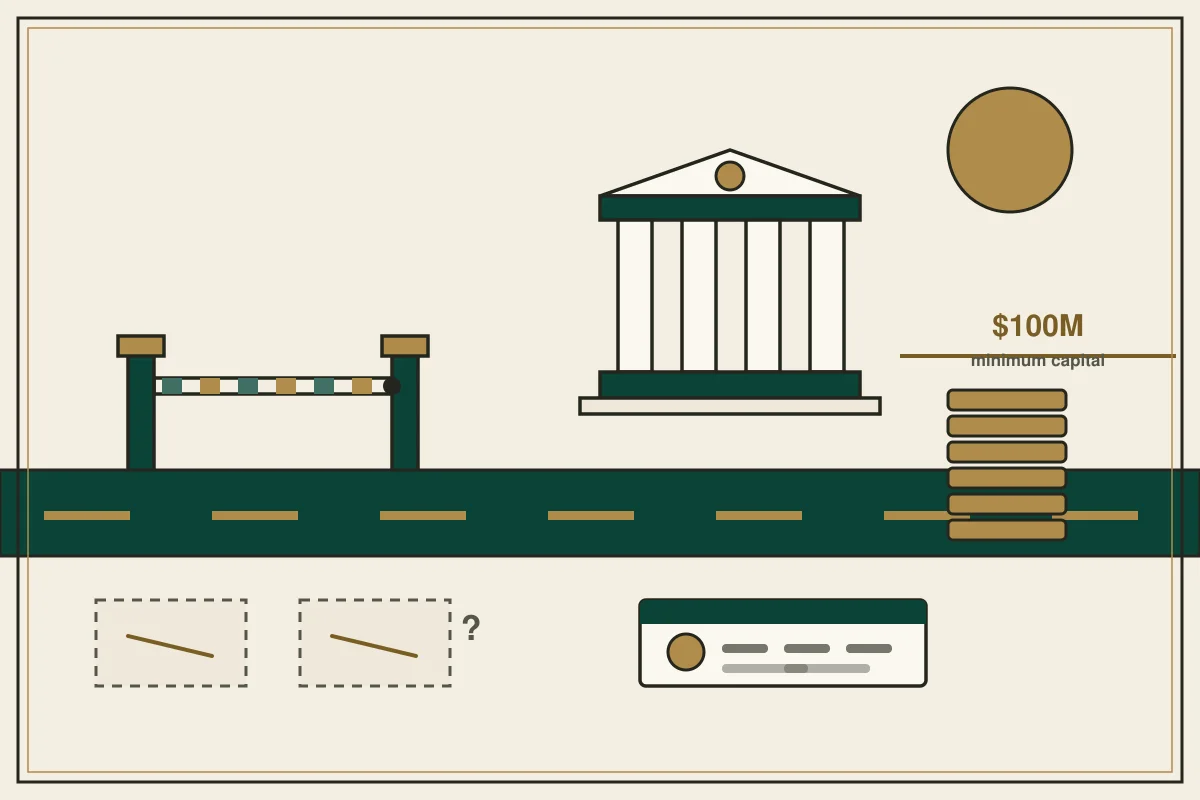
Read plainly, a capital floor this high does three things to land at once, none of which is stated in the source but all of which follow directly from what a minimum-capital requirement mechanically does. It thins the pool of future entrants — fewer sponsors can clear $100 million, so fewer new licences compete for border sites. It hardens the position of whoever already holds a licence, since a materially higher floor makes a new competitor harder to stand up from scratch. And it strands any site whose backers cannot clear the floor, whether that means an existing sub-scale operator or land held on the assumption that a casino licence would eventually attach to it. None of this is speculative dressing — it is simply what a capital floor does to a licensed-entry market. What the source does not give is any way to know which of Cambodia’s roughly 100 existing casinos would actually meet a $100 million test if applied retroactively, whether the floor applies only to new licences or also to renewals, or any grandfathering provision at all [S-1]. Treat the filter effect as directionally correct and the specifics as genuinely unknown until a sub-decree or prakas is published.
Siem Reap’s exclusion is now permanent, in his own words
The Prime Minister used the same remarks to close a door that reporting has periodically suggested was still ajar. Noting that “some businessmen are requesting licences to open casinos in Siem Reap,” he said plainly: “I want to make it clear that the government will not grant any licences for opening casinos in Siem Reap.” He went further: “If you want to open a hotel, we will allow it, but for casinos, we will never allow it. Even if the Siem Reap economy falls because of no casinos, let it be” [S-1]. That is about as unambiguous as a policy statement gets, and it lands on a market this platform already reads as a near-pure tourism bet constrained by a genuine structural supply cap — Angkor-driven height limits on new condo stock. Casino capital was never part of that thesis; this removes any lingering ambiguity about whether it might become one. Hotels remain explicitly welcome — the exclusion is casinos specifically, not hospitality investment generally.
Poipet, in the Premier’s own words
The casino remarks did not arrive in isolation — they followed a direct acknowledgment of what Poipet is going through. “Some areas are impacted by the crackdown on online scam operations. I see it in Poipet, and please kindly understand. But we must fight this battle,” Hun Manet said [S-1]. He tied the pain explicitly to two causes behind Cambodia’s tourism decline — “the impact of war, and second is the safety concern caused by online scams” — framing the crackdown itself as “short-term pain which impacts some citizens” and urging affected residents to find temporary alternative jobs or businesses in the meantime [S-1]. He noted that other border provinces “can breathe as we restore some economic activities,” while Poipet specifically remains constrained by the closed Thailand border and an unresolved diplomatic process with no stated timeline [S-1]. The same piece carries the tourism backdrop against which all of this sits: international arrivals fell 47.9 percent to 1.75 million in the first half of 2026, down from 3.36 million a year earlier [S-1] — the scale of decline the Premier was responding to when he ordered the tourism-sector review that produced these casino remarks in the first place.
Honest sizing
Restate the limits plainly, because they govern how far any of this should travel into a land thesis. This is remarks at a ceremony, not a published instrument — no sub-decree, prakas, or licensing circular accompanies the $100 million figure anywhere in the source [S-1]. “About 100 casinos” is the Prime Minister’s own count, not a cited registry, and there is no per-province breakdown, no list of which operators meet or fail the new floor, no revenue or tax data, and no land valuation anywhere in the piece [S-1]. “Las Vegas and Macau” is Hun Manet’s own comparison, not language drawn from any gaming law. Treat every number in this article as attributed to the Premier, at that ceremony, on that day — genuinely significant if it becomes codified, but not yet a documented policy a buyer can cite chapter and verse.
What to watch
- Whether a sub-decree or prakas actually codifies the $100 million floor — until one is published, this is a stated intention, not enforceable law.
- Whether the review of “about 100” casinos produces a published count, a revocation, or a consolidation — the mechanism, not just the number, is what would actually move land values in specific towns.
- Whether any grandfathering provision surfaces for existing sub-$100M operators, which would determine whether the filter effect described above hits only future entrants or reshapes the current licence-holder base too.
- Whether Poipet’s border-crossing status changes — the Premier’s own framing ties the town’s pain to the closed Thailand border and an unresolved diplomatic process, not to casino policy, which the $100 million floor does nothing to address.
The takeaway
A casino licence in Cambodia has always been the actual asset behind border-town gaming land, not the building sitting on it, and a $100 million capital floor is the clearest evidence yet that the government is treating licensing as the lever it actually is. The mechanical effects are real even without a published decree: fewer future entrants, a defensible moat for current holders, and stranded prospects for anyone who cannot clear the floor. Siem Reap’s exclusion is now stated in the Premier’s own words as permanent, closing off casino capital from a market this platform already treats as a tourism-and-supply-cap story rather than a gaming one. None of this resolves Poipet’s specific problem — a closed land border and an unresolved diplomatic process the Premier himself says has no near-term deadline. Read the $100 million figure as a real policy signal and a real filter on future licensing, and read everything else here — the exact mechanics, the grandfathering, the list of who already qualifies — as genuinely unknown until a legal instrument, not a ceremony, puts it in writing. None of this is investment advice; verify current licensing requirements and any specific operator’s status with qualified local counsel before acting on a border-town casino-adjacent position.
Sources
- [S-1] Khmer Times — Hun Manet acknowledges Poipet’s economic pain, rules out Siem Reap casinos — PM Hun Manet’s remarks at the Luang Mè Hospital inauguration, Phnom Penh: $100 million minimum casino-operator capital requirement (up from a much lower prior threshold); instruction to review Cambodia’s roughly 100 casinos and assess whether there are too many; “Las Vegas and Macau” rationale for border-province casino licensing; permanent exclusion of casino licences from Siem Reap, quoted in full; acknowledgment of Poipet’s economic pain from the closed Thailand border and the scam crackdown, framed as short-term; international tourist arrivals down 47.9% to 1.75 million in H1 2026 from 3.36 million a year earlier. Published 16 Sep 2026.
Frequently asked questions
What is the new minimum capital requirement for a casino licence in Cambodia?
PM Hun Manet said the government has raised casino-operator capital requirements to $100 million, up from a threshold low enough that, in his words, 'even a small building could open a gambling area.' This comes from his own remarks at a hospital inauguration ceremony — no sub-decree, prakas or licensing circular has been cited or published alongside it. Treat it as an announced policy position, not yet a documented legal instrument.
How many casinos does Cambodia actually have?
About 100, per Hun Manet, who has instructed relevant authorities to review that number and assess whether the country has too many. No per-province breakdown, no operator list and no count of how many existing casinos would meet the new $100 million floor has been published. Treat 'about 100' as the Prime Minister's own figure, not an audited registry.
Will Siem Reap ever get a casino?
The Prime Minister says no, permanently. Responding to businessmen still requesting casino licences there, he said: 'If you want to open a hotel, we will allow it, but for casinos, we will never allow it. Even if the Siem Reap economy falls because of no casinos, let it be.' That closes off casino capital as a demand source for a market this platform already reads as a tourism bet constrained by Angkor height limits — permanently, on current policy.
Does the $100 million floor make Poipet or Bavet land more valuable?
Not automatically, and not evenly. A higher capital floor thins the pool of operators who can enter, which can make existing licences more defensible for whoever already holds one — but it does nothing to reopen the closed Thailand border driving Poipet's specific downturn, and nothing here discloses which sites or sponsors actually clear the new floor. It is a filter on future entrants, not a value injection into current stock.