

General research for information only — not legal, tax, or investment advice. Cambodian law and markets change; figures are indicative, so verify current detail with a qualified local professional before you act.
For international buyers, the single most consequential fact about Cambodian real estate is also the most misunderstood: a foreigner cannot own land in Cambodia. Not through a clever contract, not through a long lease dressed up as ownership, not through a promise from a developer. The rule sits at the top of the legal hierarchy — Article 44 of the Constitution and Article 8 of the 2001 Land Law reserve land ownership for natural persons and legal entities of Khmer nationality, and acquiring land by falsifying nationality is a punishable offence [S-014]. Most disputes that catch foreign buyers trace back to ignoring the edges of this rule.
This article explains what you can own, the structures used to work around the
land restriction, and — most importantly — where each structure quietly shifts
risk onto you. Citations are marked [S-NNN]; the source list is at the end.
What the law actually allows
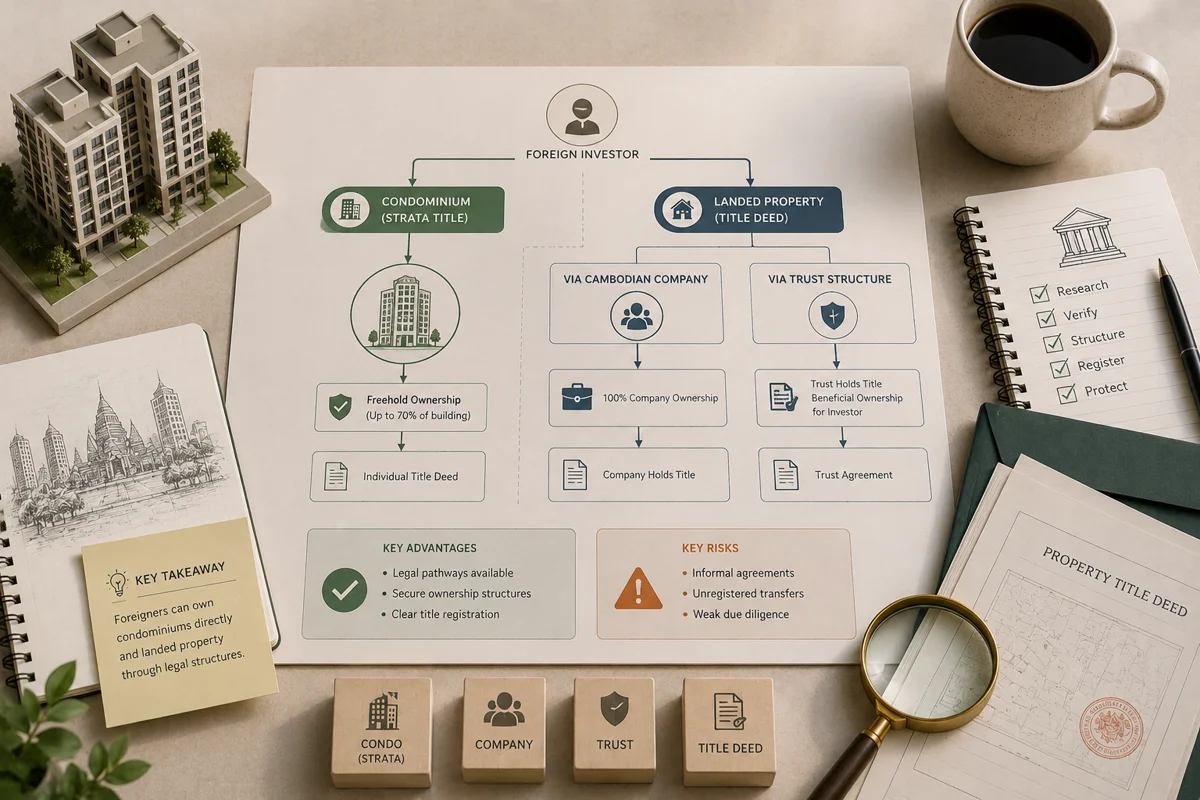
The Law on Providing Foreigners with Ownership Rights in Private Units of Co-Owned Buildings — promulgated 24 May 2010 — permits foreigners to own strata-title units: privately owned units inside a co-owned building, the local equivalent of a condominium [S-013].
There are two hard limits:
- No ground floor. Foreigners may not own ground-floor or underground units. Foreign ownership begins on the first floor and above [S-013].
- The 70% rule. Under Sub-Decree No. 82, foreigners may own no more than 70% of the total surface area of all private units in a single co-owned building. The remaining 30% must stay in Cambodian hands [S-013] [S-023]. Note the unit of measure: it is surface area, not unit count.
If a unit has a valid strata title, and the building’s foreign-ownership quota has room, a foreigner can hold that unit outright, in their own name, with a registrable title — paying the standard 4% transfer tax on registration [S-023]. This is the cleanest path and the one we steer most readers toward.
What the law forbids — and the workarounds
Everything that is not a qualifying strata unit — landed houses, villas, boreys, shophouses, agricultural and commercial land — cannot be foreign-owned directly. The market has produced four common workarounds, with very different risk profiles.
1. The nominee structure
A Cambodian individual holds the land title on your behalf, with side agreements (a loan, a mortgage, a long lease, a power of attorney) intended to give you control.
A nominee arrangement gives you contracts against a person, not rights against the land. If that relationship sours, you are litigating in a foreign legal system, in a foreign language, against a counterparty who is the registered owner.
This is not a grey area: it collides with the constitutional prohibition, and Article 8 of the Land Law makes acquiring land under a falsified nationality a punishable offence [S-014]. Reputable Cambodian law firms explicitly decline to endorse nominee arrangements [S-023]. It is the structure behind the majority of foreign-buyer horror stories; we treat it as high risk and out of scope for most readers.
2. The land-holding company
Under Article 101 of the Law on Commercial Enterprise, a company is treated as having Cambodian nationality — and may therefore own land — when at least 51% of its shares are Cambodian-held, leaving a maximum 49% for foreign shareholders [S-023]. Foreigners pair the minority stake with governance mechanisms (share classes, board control, security over the Cambodian shares) intended to give practical control.
Done by a reputable firm with proper documentation, this is a defensible landed-property route — but it is an operating company, with monthly tax filings and an annual patent-certificate renewal [S-023], and the structural fact remains that you hold a minority stake. Done cheaply, the “control mechanisms” are often unenforceable, and you are back to a nominee problem wearing a corporate suit.
3. The long-term lease
A foreigner leases land long-term — a Civil Code perpetual lease runs from 15 up to a maximum of 50 years (anything longer is automatically shortened to 50), renewable by agreement, under Articles 244–247 of the Civil Code [S-015] [S-023]. The key step is registration: a lease registered with the cadastral authority is enforceable against third parties — an unregistered one is just a contract with your landlord [S-015]. A registered lease is also commercially useful: it can be used as collateral [S-023].
This is frequently the right answer for landed property: you give up the fiction of ownership in exchange for a clean, registrable interest.
4. The regulated trust
Since the Law on Trusts (promulgated 2 January 2019), a foreigner can hold landed property as the beneficiary of a registered trust whose trustee is licensed by the Trust Regulator; the trust itself must be registered with the regulator within three months of creation [S-022]. The trustee holds legal title; you hold a registered beneficial interest.
This is no longer exotic. As of February 2025, more than $1.7 billion had been invested into Cambodia through trusts over the preceding five years — roughly 90% of it into real estate [S-024]. One major law firm calls the trust “legally the safest vehicle” for foreign investment in Cambodian land, while noting its tax treatment is still maturing [S-023].
A trust is the regulated answer to the problem the nominee structure fakes. Both leave you as a beneficiary rather than a landowner, but a trust replaces a private individual with a licensed, supervised trustee acting under a registered deed — a far stronger position than a folder of side agreements.
It is newer and less battle-tested than a lease, carries trustee fees, and demands specialist advice. But for landed property it is increasingly the route serious advisers prefer over a nominee. See our dedicated Trust Law guide for the detail.
Where the real risk sits
Notice that the dangerous part is rarely the headline structure — it is the title underneath it and the documentation around it. Cambodia runs several title systems in parallel, and a large share of property still trades on soft title, recognised only at the commune/district level and not registered at the national cadastre [S-016].
| Title type | Registered nationally? | Suitable for foreign buyers? |
|---|---|---|
| Hard title | Yes (MLMUPC) | Underlying land cannot be foreign-owned directly |
| Strata title | Yes | Yes — the primary legal path |
| Soft title | No (local commune only) | High risk; avoid |
| LMAP title | Yes (systematic registration) | Strongest land title where available |
LMAP — the World Bank-backed Land Management and Administration Project — is essentially a GIS-mapped hard title: digitised boundary coordinates and a QR code linked to the national land registry [S-025]. Newer titles can be checked for authenticity through the government’s verify.gov.kh service, though that confirms the document is genuine, not that it is unencumbered [S-018] — the cadastral search still matters.
A beautiful unit with a weak or unregistered title is a weak asset, whatever the brochure says.
The practical takeaway
If you want to own in your own name with minimal structural risk, buy a qualifying strata unit with a valid strata title in a building with foreign quota remaining. If you want landed property, expect to use a registered long lease, a regulated trust, or a properly papered land-holding company — and budget for independent legal counsel who represents you, not the developer.
The law is workable. The losses happen in the gap between what a contract says and what is actually registered against the title.
If you want the step-by-step buying process rather than the legal theory, see Can a foreigner buy property in Cambodia in 2026? — and before money moves, run the pre-purchase due diligence checklist.
Sources
- [S-013] DFDL — Foreign Ownership and Condominiums — the 2010 Law on Foreign Ownership; 70% quota; ground-floor exclusion.
- [S-014] Land Law 2001, English text (Art. 8) — Khmer-nationality ownership requirement; Constitution Art. 44; penalty for falsified nationality.
- [S-015] BNG Legal — Long Term Leases in Cambodia — perpetual lease 15–50 years; registration required against third parties.
- [S-016] Cambodia Counsel — Land Title Due Diligence — title systems; national vs commune-level registration.
- [S-018] IPS Cambodia — verify.gov.kh property verification — title-authenticity checking.
- [S-022] BNG Legal — Trusts under the Trust Law 2019 — licensed-trustee requirement; 3-month registration window.
- [S-023] BNG Legal — Foreign Ownership of Immovable Property (2024) — Sub-Decree 82; Art. 101 Law on Commercial Enterprise; lease as collateral; trust assessment; nominee position.
- [S-024] Realestate.com.kh — Owning property via a trust in Cambodia — $1.7B+ invested via trusts to Feb 2025, ~90% into real estate.
- [S-025] ADA Engineering — Cambodia land title types — LMAP program background; GIS-mapped titles.
Frequently asked questions
Can foreigners own property in Cambodia?
Yes — foreigners can own strata-title units (condominiums) outright in their own name under the 2010 co-owned buildings law, subject to two limits: no ground-floor or underground units, and foreigners may hold no more than 70% of a building’s private-unit surface area.
Can foreigners own land in Cambodia?
No. Article 44 of the Constitution and Article 8 of the 2001 Land Law reserve land ownership for Khmer nationals. Foreigners hold landed property indirectly — through a registered long lease, a land-holding company (maximum 49% foreign), or a regulated trust.
What is the 70% rule?
Under Sub-Decree No. 82, foreigners may own at most 70% of the total surface area of all private units in a co-owned building; the remaining 30% must stay in Cambodian hands. The measure is surface area, not unit count — and a building already at quota is not foreign-ownable.