

General research for information only — not legal, tax, or investment advice. Cambodian law and markets change; figures are indicative, so verify current detail with a qualified local professional before you act.
Two separate government processes are converging on the same small district
in Kandal province at the same time, and neither one is a decided fact yet.
Cambodia’s transport ministry and JICA have been working through the
feasibility study for a new Mekong River bridge that would land at
Areyksat — and a permanent 22-hectare public park has just been sited in
the same area. This is a ministerial progress meeting, not a signed deal,
and that limit matters enough to state here, in the second paragraph, rather
than as a caveat tacked onto the end: no loan amount, no financing
instrument, no construction contractor, no timetable, no start date, and no
land-acquisition area have been published for the bridge. What follows is an
honest account of exactly how far this has actually progressed, why Areyksat
is worth naming now rather than waiting for a groundbreaking, and why the
same district’s other headline this month — a park, not a project — cuts the
other way on land value. Citations are marked [S-N]; the source list is at
the end.
What actually met, and who was in the room
Cambodia and Japan held a progress-update meeting on the “National Road 1 and Mekong Bridge Development Project,” chaired by MPWT Minister Peng Ponea [S-1]. The attendee list is worth reading closely rather than skimming: ministry leadership, representatives from JICA headquarters in Japan and the JICA Cambodia Office, and — from the Ministry of Economy and Finance — the General Department of International Cooperation and Debt Management and the General Department of Resettlement [S-1]. That last department’s presence is the tell. Resettlement agencies do not typically attend meetings for projects with no land-acquisition component, so its presence is a genuine signal that land acquisition is somewhere in scope for this project. It is not, on its own, confirmation of a specific acquisition area, a compensation framework, or which parcels are affected — none of that appears in the source [S-1].
The meeting followed a kick-off briefing by a Fact-Finding Mission Team, after which officials reviewed the project’s feasibility study report in detail, covering technical and financial aspects, environmental and social impacts, and a finalised action plan [S-1]. Read that phrase precisely: the environmental and social impact work is described as reviewed, not disclosed. Nothing about what that review found has been published alongside this readout.
The project as described
The scope, per the same meeting: widening a 53-kilometre section of National Road 1 from two lanes to four or six lanes depending on the section, adding urban viaducts, and building a new Mekong River bridge connecting Phnom Penh to the Areyksat area of Kandal province [S-1]. The plan ties this into an outer ring road, intended to serve the Southern Economic Corridor and cross-border traffic between Phnom Penh and Vietnam, with stated goals of lower logistics costs, reduced urban congestion, and “promoting economic growth in areas surrounding the capital” [S-1]. The source describes the project as having “financial support from JICA” — that is the source’s own wording, and this article does not upgrade it into a confirmed loan. Officials at the meeting agreed on “the direction of work” and committed to continued cooperation “toward realisation in accordance with the plan in the near future” [S-1] — language that describes alignment on intent, not a signed financing package.
The stage ladder, applied
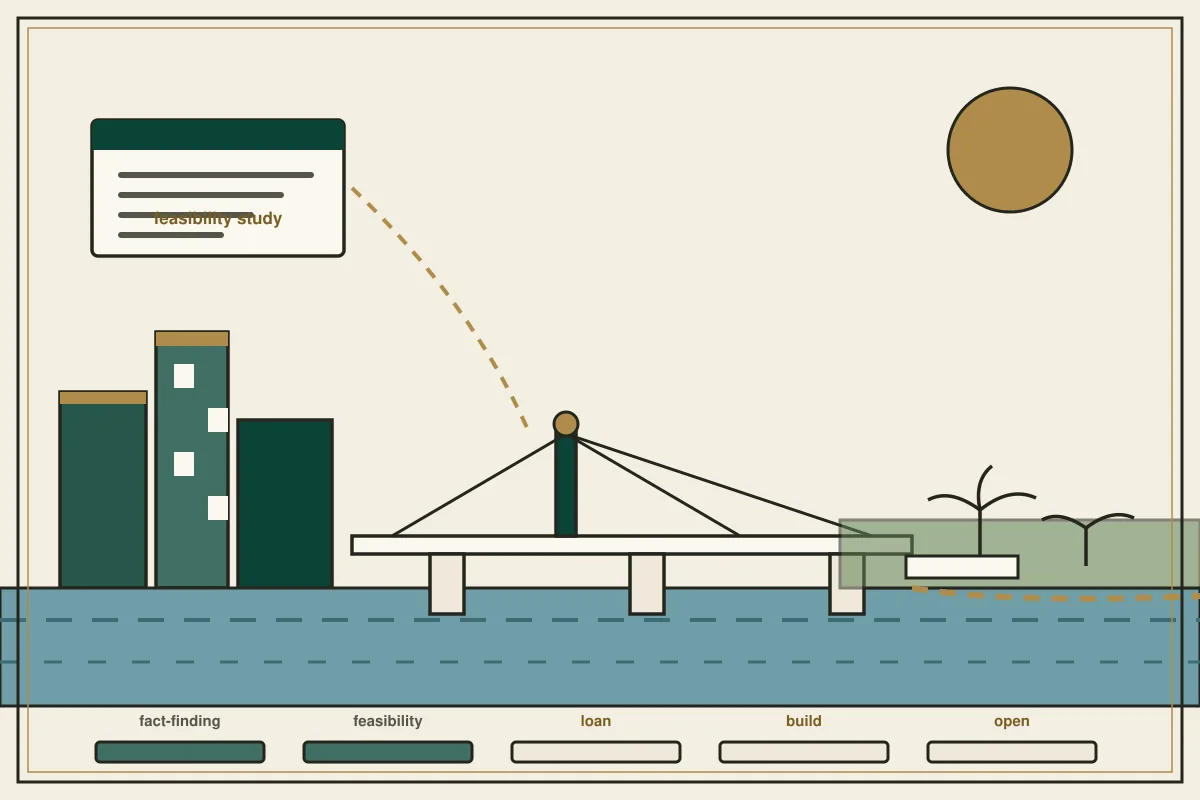
Infrastructure projects that eventually move land prices go through recognisable stages, and the gap between them is exactly where speculative pricing gets ahead of reality. This project’s stages, as far as this source documents them: fact-finding mission → feasibility study review (where this project sits today) → loan agreement (not yet reached) → construction (not yet reached) → opening. Each rung entitles a buyer to progressively more confidence, and this project has cleared only the second of five. A feasibility study review confirms the government and its partner are seriously scoping the project’s technical and financial shape. It does not confirm financing is secured, that a contractor has been chosen, that a right-of-way has been fixed, or that construction will start on any particular date — none of which appear anywhere in this source [S-1]. Buyers along Phnom Penh’s southern and south-eastern fringe have, in this platform’s own experience covering the region, routinely priced land as if a corridor were already at the construction-or-later stage when it was still at fact-finding. This project is not yet there.
Areyksat, in plain terms
Areyksat sits on the Mekong’s far bank from central Phnom Penh, and a bridge connecting it to the capital and an outer ring road would be a genuine structural change if it happens — the kind of link that turns a district defined by its distance from the city into one defined by its connection to it. But this platform’s own coverage of comparable cases argues for caution rather than promotion at this stage. The Techo International Airport corridor and the Bavet–Poipet border towns both show what a confirmed, built piece of infrastructure does to surrounding land — and both also show how much speculative narrative accumulates around a project long before anything is confirmed. A fact-finding-and-feasibility-stage bridge is exactly the point in that cycle where a rumour can outrun the ministry readout that actually describes it. Treat “Areyksat” as a name now worth tracking through subsequent stages, not as a corridor already worth paying a premium for.
The other headline in the same district: a park, not a project
Read the bridge news against a separate, unrelated process that happens to land in the same area. On 1 September 2026, MLMUPC Secretary of State Chhoeun Bunnarat led a technical working team to inspect sites for two public-space projects in Kandal province: a proposed 42-hectare Boeng Tboung Park in Khsach Kandal district, and a proposed 22-hectare Boeng Damrei Srut Park in Arey Ksat city — 64 hectares combined [S-2]. Both are named for water bodies (“Boeng” means lake), and both are at concept stage: initial concepts were drafted by district and municipal administrative teams, with ministry experts still to refine architectural and engineering designs following this field assessment — no budget and no contractor have been disclosed for either [S-2]. The source’s own framing ties the designation to growth pressure, not to scarcity: “As Khsach Kandal and Arey Ksat continue to attract real estate investments and urban migration, preserving natural water bodies and designating permanent green reserves serve as key measures to mitigate urban heat island effects and enhance spatial liveability” [S-2].
Read that correctly rather than as another growth signal. A permanent green-space designation is the opposite of a land windfall for the parcel it covers — land inside a 22-hectare park boundary is being taken off the developable ledger, not added to it. The more defensible reading is a smaller, softer one: a designated public park can be a liveability amenity for land just outside its boundary, in the way parks generally support nearby residential value elsewhere. That is a materially weaker claim than “Arey Ksat is about to boom,” and it is worth holding both processes — a prospective bridge and a prospective park — in the same district without letting either one borrow credibility from the other. They are unrelated government initiatives that happen to share a place name and a concept stage in common, not two halves of one growth story.
Honest sizing
State every limit plainly, because they govern how far this should travel. This is a ministerial progress meeting, not a signed agreement — no loan amount, no financing instrument, no EPC contractor, no construction timetable, and no land-acquisition area appear anywhere in the source [S-1]. “Financial support from JICA” is attributed language from the source, not a confirmed loan. The environmental and social impact work was reviewed, not published. The resettlement department’s attendance is a signal that land acquisition is in scope, nothing more specific than that. And the park proposal is a concept-stage site inspection, with no budget or contractor for either of the two parks under review [S-2].
What to watch
- Whether a loan agreement gets signed, and for how much — the actual rung that would move this from “under review” to “financed.”
- Whether an EPC contractor or a construction start date is named — the next concrete milestone after financing.
- Whether a land-acquisition area or compensation framework is published — the resettlement department’s presence at this meeting is the reason to watch for this specifically, not a reason to assume it.
- Whether the Boeng Damrei Srut Park concept produces an actual boundary map or budget — until it does, treat “22 hectares” as a proposed figure, not a fixed one.
The takeaway
A Mekong bridge to Areyksat and a 53-kilometre National Road 1 widening are real enough to have cleared a feasibility study review with JICA and Cambodia’s transport ministry — genuinely further along than most corridor rumours this platform tracks, and worth naming for the first time because of it. But “feasibility study reviewed” is two stages short of “financed” and three short of “built,” and nothing in the readout — no loan figure, no contractor, no land-acquisition map — lets a buyer treat Areyksat as anything more than a name to watch. The same district’s other news this month, a proposed 22-hectare park, cuts the opposite direction from a growth story: it is land being permanently withdrawn from development, not added to it. Hold the two processes separately, track both through their own next stages, and resist pricing either one as if it were already resolved. None of this is investment advice; verify current project status, land-use designations and any specific parcel’s exposure to either process directly before committing capital in the area.
Sources
- [S-1] Khmer Times — Govt speeds up National Road 1, Mekong Bridge projects — MPWT–JICA progress-update meeting on the National Road 1 and Mekong Bridge Development Project, chaired by MPWT Minister Peng Ponea; attendees including JICA headquarters and Cambodia Office, MEF’s General Department of International Cooperation and Debt Management, and the General Department of Resettlement; Fact-Finding Mission Team kick-off briefing and detailed feasibility study review (technical, financial, environmental and social impacts, action plan); scope of 53 km of National Road 1 widened two-to-four/six lanes with urban viaducts, plus a new Mekong River bridge connecting Phnom Penh to Areyksat, Kandal, tying into an outer ring road serving the Southern Economic Corridor; “financial support from JICA” stated without a loan amount or instrument. Published 16 Sep 2026.
- [S-2] Construction & Property News — Cambodian Land Ministry Inspects 64-Hectare Public Park Developments in Kandal Province — 1 September 2026 site inspection led by MLMUPC Secretary of State Chhoeun Bunnarat covering two concept-stage public-park proposals in Kandal: 42-hectare Boeng Tboung Park (Khsach Kandal district) and 22-hectare Boeng Damrei Srut Park (Arey Ksat city); no budget or contractor disclosed for either; ministry framing ties the designations to growth pressure and liveability rather than scarcity. Published 10 Sep 2026.
Frequently asked questions
Has a Mekong bridge to Areyksat actually been approved?
No. MPWT and JICA held a progress-update meeting reviewing the project's feasibility study — technical, financial, environmental and social aspects, plus an action plan. That is the rung before a loan agreement, which is itself the rung before construction. No loan amount, financing instrument, EPC contractor or start date has been published. Treat this as a project moving through review, not a funded, dated commitment.
Is JICA financing the Areyksat bridge?
The source describes the project as having "financial support from JICA," but names no loan amount, no signed instrument, and no disbursement structure. JICA headquarters and its Cambodia office attended the review alongside Cambodian debt-management officials, which is consistent with a financing relationship still being worked out — not confirmation that a specific JICA loan has been signed.
Does the presence of a resettlement department mean land will be seized in Areyksat?
It means land acquisition is in scope, not that it has been decided or mapped. Cambodia's General Department of Resettlement attended the same meeting as MPWT, JICA and the debt-management department — its presence is a signal worth taking seriously, since resettlement agencies do not typically sit in on meetings for projects with no land-acquisition component. But no acquisition area, compensation framework or affected-parcel map has been published.
Does the new 22-hectare park in Arey Ksat mean the district is about to boom?
Read it the other way. Boeng Damrei Srut Park is a 22-hectare permanent green-space designation over a water body in Arey Ksat, at concept stage with no budget or contractor. Land inside that boundary is being taken off the developable ledger, not added to it — the opposite of a windfall. It may support a liveability case for land just outside the park's edge, but that is a smaller, softer claim than a park announcement usually implies.