

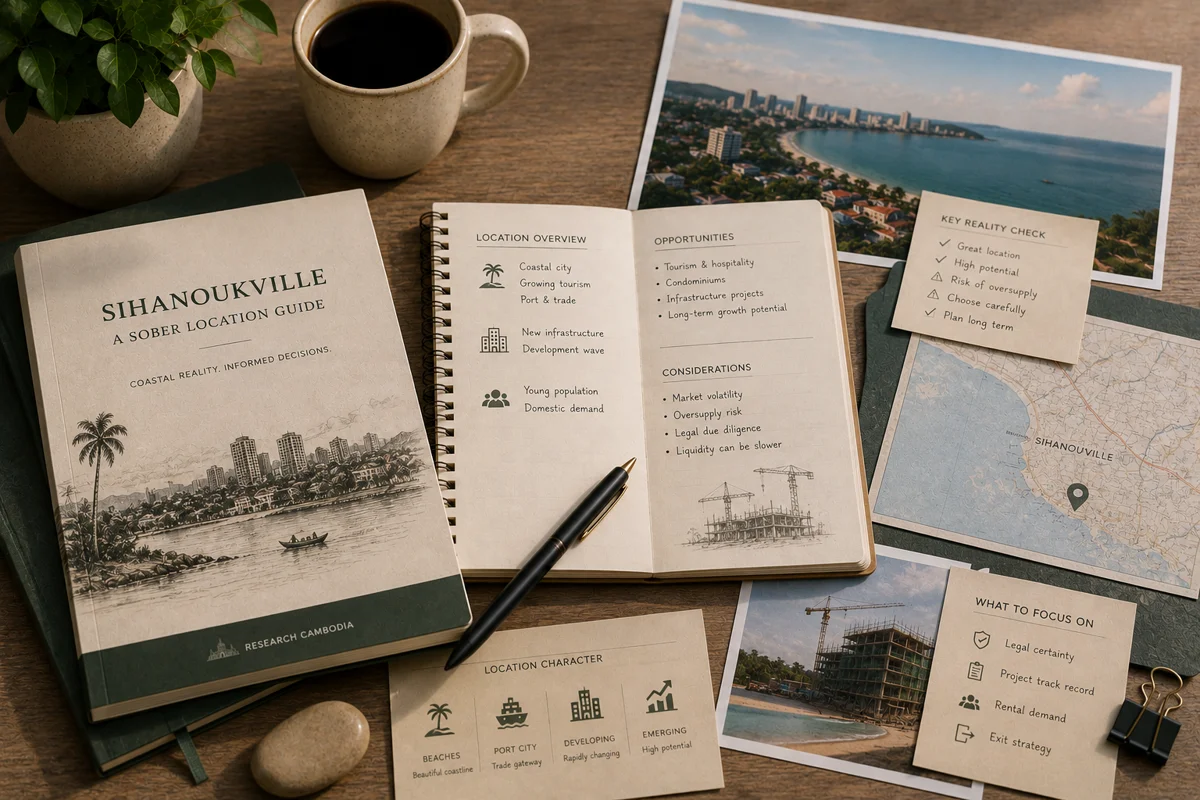
General research for information only — not legal, tax, or investment advice. Cambodian law and markets change; figures are indicative, so verify current detail with a qualified local professional before you act.
No Cambodian location splits opinion like Sihanoukville. In the space of a few
years it went from sleepy beach town to frenzied casino-and-construction boom to
a landscape of half-finished towers — and is now, slowly and unevenly, working
on a third act. For investors, it is the highest-variance market in the country.
This guide is deliberately unromantic. Citations are marked [S-NNN]; the
source list is at the end.
For the coastal market’s current pricing and yields against the other cities, see the Cambodia Price & Yield Index.
The boom and bust, in numbers
Sihanoukville’s modern history as a property market is dominated by a single episode. A largely Chinese-capital construction boom centred on gaming drove rents, leases, and land prices up severalfold between 2017 and 2019. Then, in August 2019, the government banned online gambling licences — and the engine stopped. An estimated 120,000 Chinese nationals left Cambodia in the weeks after the directive [S-037]; local business associations reported commercial leases down as much as 85% and land sales down 25%, with prices falling by a third in some areas [S-037].
What that left behind is the defining fact of the market today:
- Roughly 360–400 stalled buildings in and around the city centre — counts vary by scope and date [S-034] [S-035] — within a wider provincial picture where unfinished projects have been put at 70–80% of all 1,155 recorded developments [S-036].
- An estimated $1 billion or more of additional investment needed just to complete the city-centre shells [S-035].
Any honest location guide has to start there rather than with the beaches.
The third act: real program, open questions
The government is not ignoring the problem. The Special Investment Promotion Programme for Preah Sihanouk Province, launched in 2024 and extended to 2027, had approved incentives for 467 projects worth a headline $8.18 billion by February 2026, including 209 linked to unfinished structures [S-034]. Some shells are being completed; that is genuine progress.
The two open questions are the honest investor’s whole case:
- How much of that headline capital is actually being deployed? Approval of an incentive is not a crane on site, and independent reporting notes it remains unclear how much money has genuinely flowed into completing stalled projects [S-034].
- Structural quality. Buildings abandoned mid-construction and exposed for years are hard to certify and hard to resell — practitioners cite the physical quality of the shells as a core obstacle, alongside the property downturn in China, where most of the original capital came from [S-034].
There is also a newer shock with two faces. Since mid-2025, authorities have shut around 250 scam compounds and more than 90 casinos [S-034]. Long term, dismantling the scam economy is precisely what the city needs to become investable for legitimate capital — and Sihanoukville’s association with that economy has been a real reputational drag. Short term, it removes yet another demand source: tenants, workers, and spending that parts of the property market were quietly leaning on [S-034]. A genuine third act has to work without that demand ever coming back.
The legitimate-infrastructure case, meanwhile, is real: the $2 billion Phnom Penh–Sihanoukville expressway opened in October 2022, cutting the journey from about five hours to two [S-038], and the city remains Cambodia’s principal deep-water port and gateway to Koh Rong and Koh Rong Sanloem — see the expressway corridor guide for how we weigh road-driven theses.
The government’s most recent recovery signal is a Preah Sihanouk Tourism Development Plan 2026–2030, launched 14 September 2026 by the Tourism Ministry and provincial governor, positioning the province as a “second city” core built on smart-city and sustainable-development messaging [S-039]. Read it in context, not in isolation: Sihanoukville is the fifth province to launch a plan on the same 2026–2030 template — Phnom Penh (17 August), Kratie (7 September) and Kampong Thom preceded it, all following a near-identical 2021–2025 cycle with similar levers (brand identity, night-time economy, longer stays) [S-039]. This is a launch ceremony, not a project: no budget, no project list, no land allocation and no arrival or investment targets were disclosed. Whether the province’s outcomes end up meaningfully different from the template it shares with four other provinces is an open question this plan alone does not answer.
Who Sihanoukville suits
- Infrastructure-thesis buyers with a long horizon, betting on the port, the expressway, and special-economic-zone activity rather than on tourism or gaming — and sizing the position so a slow decade doesn’t hurt.
- Operators, not passive owners — people who can actively run a hospitality or rental business and manage on the ground or through trusted partners.
Who it does not suit
- Passive, remote, income-now buyers. Vacancy and management risk here are among the highest in the country, and the demand base is still being recomposed as the scam economy is removed [S-034].
- Anyone relying on resale liquidity. Exit can be slow and price discovery poor — especially for units in stalled or troubled developments, where the structural-quality question [S-034] hangs over any future sale.
In Sihanoukville the building’s completion status and developer solvency matter more than location, view, or price per square metre. A cheap unit in a stalled tower is not cheap — it is stranded. There are hundreds of stalled towers [S-034] [S-035]; the discount is not an anomaly, it is the market.
The due-diligence list is different here
Standard Cambodian due diligence applies — title, foreign quota, registration (start with the checklist) — plus questions specific to this market:
- Is the development actually finished and operating, or is “nearly complete” doing a lot of work in the pitch?
- Is the developer still solvent and present in Cambodia? The original capital base was overwhelmingly Chinese, and China’s own property downturn limits how much of it returns [S-034].
- If the project claims revival-program backing: incentive approval or money on site? Ask what has physically happened since approval [S-034].
- Does the building have functioning management and utilities today — not promised, but running?
- What is the realistic occupancy of comparable completed buildings nearby — measured now, after the scam-economy closures, not from 2024 listings?
Our position
Sihanoukville can work — for the right investor, with the right thesis, doing the right diligence, on a completed and operating asset. The expressway and the port are real; the revival program is real but unproven at the capital-deployment level; and the demand base is being deliberately rebuilt from a smaller, cleaner foundation. For most of our readers seeking relatively passive, defensible income, the risk-adjusted case remains harder to make than in central Phnom Penh. We would only look at completed, operating buildings, and we would size the position as the speculative allocation it is.
Sources
- [S-034] CamboJA News — Sihanoukville stalled projects persist as scam crackdown reshapes economy — ~400 stalled buildings; revival-program approvals vs deployment; structural-quality obstacle; 2025–26 scam/casino closures.
- [S-035] Cambodianess — End in Sight for Sihanoukville Unfinished Buildings — ~360 incomplete buildings at start of 2024; ~$1B completion estimate.
- [S-036] Construction & Property News — More than 1,000 unfinished buildings — province-wide stalled-project share.
- [S-037] RFA — 120,000 Chinese nationals depart after online gambling ban — the August 2019 ban and exodus; post-ban lease/land-sale collapse figures.
- [S-038] gov.cn — Phnom Penh–Sihanoukville Expressway opening — $2B cost, October 2022 opening, travel-time reduction.
- [S-039] Khmer Times (Khmer edition) — 16 Sep 2026; event 14 Sep 2026, Independence Hotel. Preah Sihanouk Tourism Development Plan 2026–2030 launch by Tourism Ministry Secretary of State Huot Hak and Governor Mang Sineth; “second city” positioning; smart-city/sustainable-development framing. Corroborated by Cambodge Mag (16 Sep 2026), which supplies the province sequence (Phnom Penh 17 Aug, Kratie 7 Sep, Kampong Thom, Preah Sihanouk fifth) and national arrivals context (−47.9% H1 2026). No budget, project list, land allocation or targets disclosed in either source.
A data honesty note: stalled-building counts for Sihanoukville range from ~360–400 (city-centre, recent) to 1,000+ (province-wide, all project types) depending on scope and date. We quote the range and the source for each. The $8.18B revival figure is approved-incentive value, not verified deployed capital — the article treats it accordingly.