

General research for information only — not legal, tax, or investment advice. Cambodian law and markets change; figures are indicative, so verify current detail with a qualified local professional before you act.
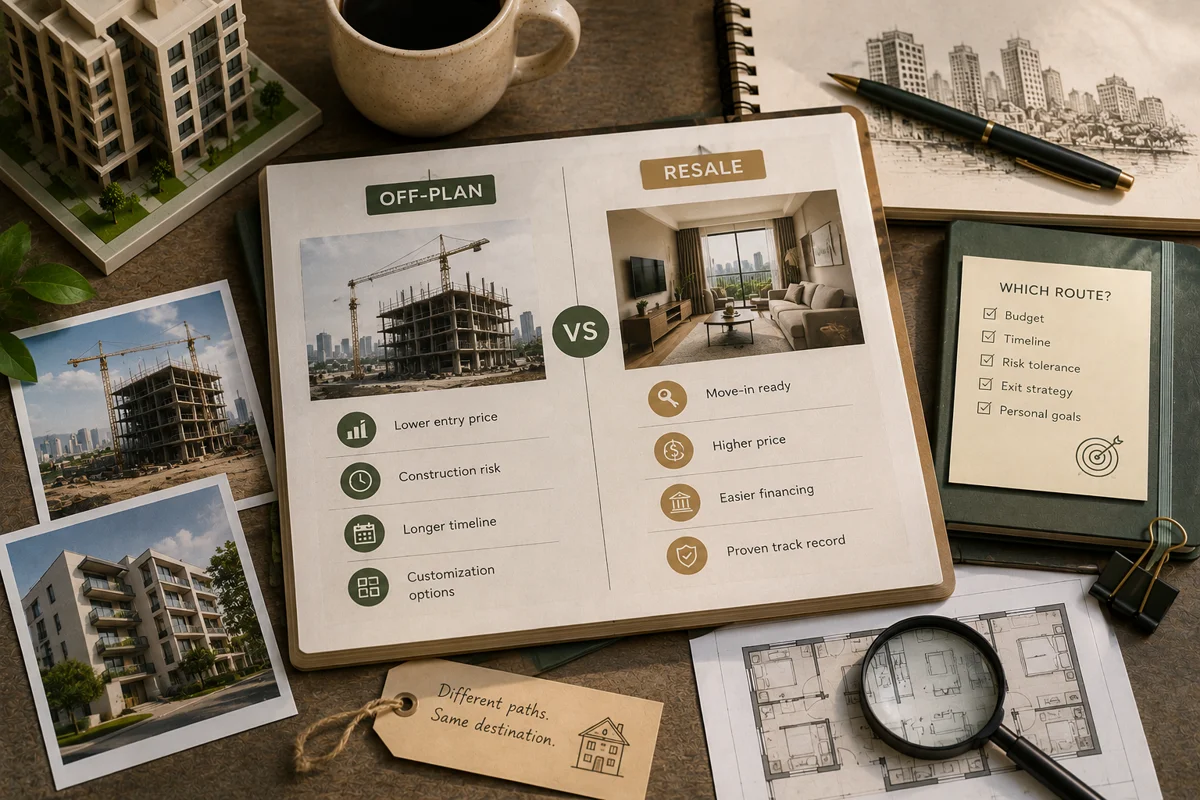
There are two fundamentally different ways to buy in Cambodia, and they carry
opposite risk profiles. Off-plan means buying from a developer before — or
during — construction, on the strength of a plan and a promise. Resale means
buying a completed unit on the secondary market, where what you see is what you
get. Most of the worst outcomes and the best bargains both live in the off-plan
column; resale is the steadier, costlier road. This guide matches the route to
the buyer. Citations are marked [S-NNN]; the source list is at the end.
The one-line version
- Off-plan — lower entry price, staged payment, the best unit selection, and the newest stock; in exchange for completion and developer risk and the fact that you can’t see what you’re buying.
- Resale — what you see is what you get, immediate rental income, a building whose quality and management you can actually inspect; in exchange for a higher price, older stock, and a thinner selection.
Off-plan: the case and the risk
The appeal is real: developers price off-plan below completed value, offer instalment payment plans that are the closest thing to leverage many foreign buyers can get, let you choose the best units in a building, and deliver brand-new stock.
The risk is equally real, and it’s concentrated in one place: the developer. You are handing over money against a promise to deliver a finished, titled unit years from now — and the structure of the deal offers little shelter: escrow is not standard practice in Cambodia, so your instalments typically flow straight to the developer and fund the build, while deposits paid after the SPA are often non-refundable [S-095]. The thin statutory protection is the licensing regime’s 2 percent capital deposit with the NBC [S-020]. If the developer is late, under-delivers, cuts quality, or stalls, your capital is exposed with little recourse — and “stalls” is not hypothetical: Sihanoukville alone carries 360–400 unfinished towers, roughly a billion dollars short of completion, left by exactly this model when sales stopped [S-034] [S-035]. The market can also soften between purchase and completion — Phnom Penh prices spent 2025 some 15–20 percent below their 2019 peak while supply kept arriving [S-026] — leaving you above water on paper. The risk also scales with how unproven the builder is: at the far end sit zero-record debuts like MIRAKU Capital’s planned 67-storey G.A.T.O Tower, where every one of these cautions applies at full strength with no delivery history to discount it. This is why vetting the developer is the entire game off-plan — read our how to vet a developer guide before any payment plan tempts you, and treat guaranteed-return schemes with the scepticism they deserve.
Resale: the case and the risk
Resale removes the biggest off-plan unknowns. You can inspect the actual unit, walk the finished building, see its occupancy and upkeep, assess the management company and sinking fund, and confirm the title is issued — all the things an off-plan buyer can only take on trust. (The full second-owner inspection list is in our resale checklist.) You can also earn rental income immediately rather than waiting through construction.
The trade-offs: resale stock is priced higher than off-plan (you’re paying for certainty and a finished asset), it’s older, the selection is thinner, and you inherit whatever you don’t catch — defects, title history, a weak building management, or a foreign-ownership quota that’s already full (the law caps foreign ownership at 70 percent of a building’s private-unit area, and central expat-favoured buildings are where the cap binds [S-013]). The risk shifts from “will it be delivered?” to “what am I inheriting?”, which is a risk you can actually inspect — title authenticity by QR, registered burdens at the cadastre [S-018] — so due diligence on the unit, the building, and the title is where a resale purchase is won or lost.
Price and payment
Off-plan is cheaper on the headline and payable in stages — condo plans typically run on fixed-date schedules [S-095]; resale is dearer and usually wants the full price in cash. But compare all-in: an attractive off-plan instalment plan can be priced into a higher number, and a resale unit with a working tenant arrives with income an off-plan unit won’t see for years — in a market where completed buildings report occupancies in the high-70s to low-80s percent [S-027], that bird in hand is worth real money. One 2026-specific note: the stamp-duty exemptions (to $70,000 on borey/condo units, $210,000 for first-time buyers) apply to purchases from licensed developers through end-2026 [S-021] — a genuine, time-limited thumb on the off-plan side of the scale for qualifying buyers. Run both against your actual funding route.
Risk profile, side by side
- Off-plan risk is forward-looking and largely outside your control — completion, timing, quality, and the developer’s solvency. You manage it by vetting the developer and structuring the payments, not by inspection.
- Resale risk is present and inspectable — condition, title, building management, quota. You manage it by diligence before you sign.
If you can’t stomach handing money to a promise, resale is your route. If you can vet hard and wait, off-plan can pay for the risk you take.
Liquidity and the eventual exit
Off-plan adds an exit wrinkle: reselling before completion means assigning your contract, which depends on the developer allowing it and on finding a buyer amid competing new launches. A completed resale unit is a known quantity in the secondary market. Either way, plan the exit from the start, and run the asset well in between (see property management).
Which route suits whom
- Off-plan suits the risk-tolerant buyer who wants choice, new stock, or a payment plan, will vet the developer rigorously, and can wait through construction with capital they can afford to have tied up.
- Resale suits the buyer who wants certainty, immediate income, and to see exactly what they’re buying — typically a cash buyer with lower risk tolerance.
- Default to resale unless you have a specific reason (and the diligence discipline) to take the off-plan bet — the inspectable risk is the easier one to manage.
Before you commit
- Off-plan: vet the developer hard, scrutinise the payment schedule and any escrow/completion protections, and confirm what happens to your money if the project stalls.
- Resale: run full diligence on the unit, the building’s management and sinking fund, the title, and the foreign-quota headroom before you sign.
- Both: sort the ownership structure and underwrite on a realistic net yield.
The takeaway
Off-plan and resale aren’t better or worse — they’re different bets. Off-plan trades price, choice, and payment terms for completion-and-developer risk you can only manage by vetting and structuring; resale trades a higher price and older stock for certainty and income, with risk you can actually inspect. Match the route to your risk tolerance and your need for certainty, do the diligence each demands, and when in doubt, the inspectable road is the safer one. None of this is investment or legal advice; verify the current detail with a qualified local professional before you act.
Sources
- [S-013] DFDL — Foreign Ownership and Condominiums — the 70% foreign-quota cap.
- [S-018] IPS Cambodia — verify.gov.kh — QR title verification on resale.
- [S-020] Realestate.com.kh — Licensing a Development Project — the licensed-developer 2% NBC deposit.
- [S-021] DFDL — CGT Deferred Again — licensed-developer stamp-duty exemptions through end-2026.
- [S-026] IPS Cambodia — Phnom Penh Condo Market Trends 2025 — prices 15–20% below the 2019 peak; ongoing supply.
- [S-027] CambodiaProperty.asia — Phnom Penh Condo Market Trends — completed-building occupancy bands.
- [S-034] CamboJA News — Sihanoukville stalled projects / [S-035] Cambodianess — unfinished buildings — the 360–400 stalled towers and ~$1B completion gap.
- [S-095] IPS Cambodia — The SPA in Cambodia — escrow not standard; payment-schedule norms; deposit refundability.